

Living with persistent illness and uncertainty: Patient narratives on Lyme disease in Nova Scotia, Canada
Patients experienced misdiagnosis or dismissal, with symptoms attributed to psychological factors or aging. Persistent symptoms disrupted family roles, employment, and financial stability.
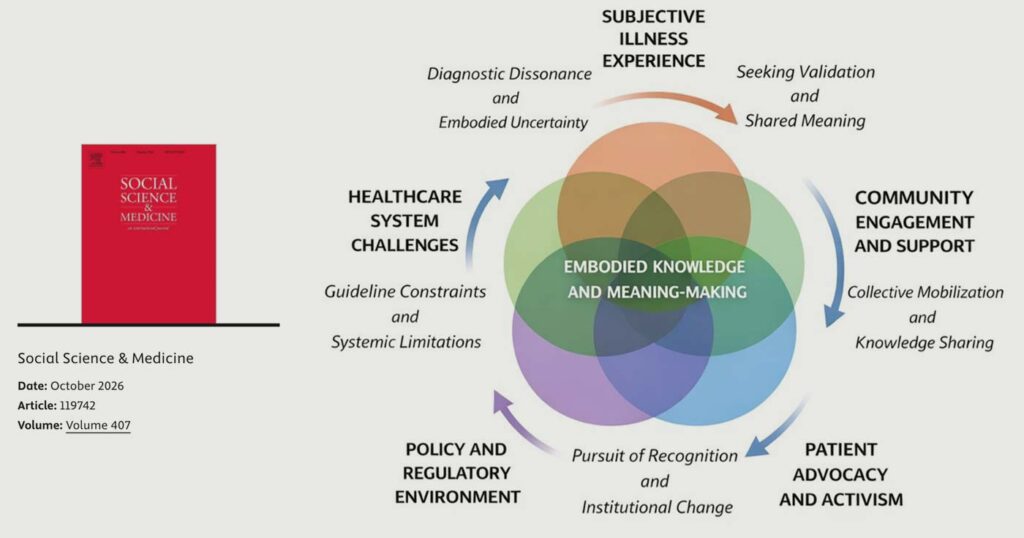
A new peer-reviewed paper by Marilyn Cox and Mario Levesque investigates the experiences of 21 individuals in Nova Scotia who are impacted by persistent Lyme disease. This study explores many of the dynamics surrounding persistent Lyme. Patients have to navigate healthcare settings in the context of a contested illness which has led to polarization and treatment options that are constrained and have systemic limitations.
Patients seek out education, become advocates, and become engaged in policy and change-making. Along the way, support networks provide validation and shared interpretive resources.
Read this open access paper.
Citation
Cox M, Levesque M. 2026 Aug. Living with Persistent Illness and Uncertainty: Patient Narratives on Lyme Disease in Nova Scotia, Canada. Social Science & Medicine.:119742. https://doi.org/10.1016/j.socscimed.2026.119742.
Abstract
Persistent, unexplained symptoms attributed by patients to Lyme disease present significant challenges within healthcare systems where diagnostic uncertainty and contested legitimacy shape clinical and institutional responses. This qualitative study draws on in-depth interviews with individuals in Nova Scotia who experience persistent symptoms following suspected or confirmed Lyme disease. Using an interpretive phenomenological approach informed by the embodied health movement framework, the analysis examines how participants interpreted their experiences and navigated interactions with healthcare and public health systems. Participants described complex diagnostic and treatment trajectories shaped by perceived testing limitations, inconsistent clinical interpretations, and limited recognition of persistent symptoms. These dynamics contributed to feelings of dismissal and uncertainty, prompting many to seek additional opinions, pursue alternative care, or engage in self-advocacy. As these struggles unfolded, participants reported broader disruptions to daily life, including shifts in family roles, relationship strain, and reduced functional capacity. Institutional messaging and jurisdictional constraints further shaped their sense of legitimacy within the healthcare system, while community networks and peer support offered crucial validation and interpretive resources. For some, these engagements extended into advocacy and public education aimed at improving recognition and care. The findings illustrate how individuals navigate the intersecting domains of embodied experience, biomedical uncertainty, and institutional structures, and how experiential knowledge becomes a resource in the absence of clear clinical consensus. This study contributes to broader discussions about contested illness, the politics of visibility, and the need for responsive, context-sensitive approaches to Lyme disease policy, communication, and care.