

Lyme disease is becoming one of Canada’s defining climate-health challenges
According to Ogden and other scientists, ticks are projected to continue their northwards expansion at a clip of 18 kilometers per year or even faster, and not just in Quebec, but in every Canadian province.

Kimberly Fosbury was wearing a vivid lime green shirt – the colour of Lyme disease awareness – when she approached the podium at the town council meeting in Caledon, Ont., on June 23. Her voice broke with emotion as she stood in front of the city mayor and council members, describing her son’s experience with the disease after a tick bite.
“I’m here to tell you that ticks are more than just a nuisance,” she said. “One tick bite can actually destroy a person’s life.”
Eight years ago, Fosbury’s son – whose name is being withheld to protect his privacy – was a bright, talkative and highly active student, dreaming of studying computer programming. But weeks after one summer soccer game during which he retrieved the ball from tall grass, he grew ill and collapsed. That event was the beginning of an excruciating, years-long journey toward his diagnosis of Lyme disease, she described at a council meeting found with CNO’s Civic Searchlight.
Today, complications of Lyme carditis, which causes an abnormal heartbeat, have left her son largely confined to his home, unable to attend school and requiring a wheelchair to venture out anywhere that might require climbing a few steps. Now, a “good day” is defined by her son’s ability to talk and eat without pain and severe fatigue.
Fosbury’s account clearly resonated within the council chamber. Several of the council members voiced sympathy and shared additional descriptions of tick-related illnesses afflicting friends and family.
Coun. David Maskell agreed with Fosbury. “This is a serious problem that is only getting worse,” he said.
Fosbury’s account – it seemed – was recognizable to other families and members of the community.

Her story also reflects a broader public health dilemma taking shape across Canada: As climate change expands the abundance, activity and the northern limits of pathogen-carrying ticks, the incidence of Lyme disease has surged.
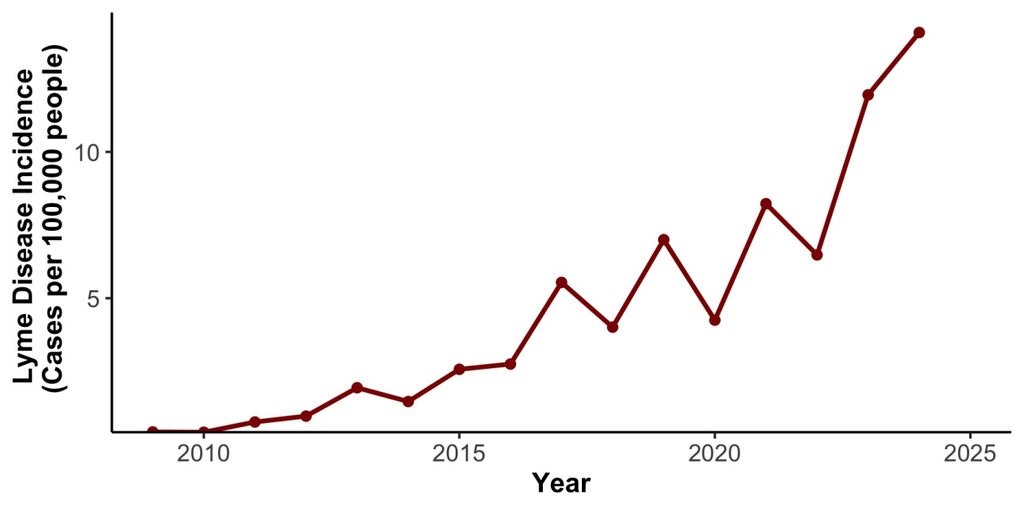
Since 2009, the per-capita incidence of Lyme disease has increased approximately 32-fold for all of Canada – with even higher increases in Nova Scotia – according to calculations by Canada’s National Observer using data from the Public Health Agency of Canada (PHAC).
Behind those eye-popping numbers are families whose lives have been upended by illness. In communities such as Caledon, residents are now urging local officials to strengthen public education and awareness about ticks and diseases they carry, raising questions about whether Canada’s overall response has kept pace with one of the world’s clearest climate-related health threats.
A wildly complicated disease
Lyme disease was originally described in the Town of Lyme, Conn., after a spate of illnesses associated with an unusual, bullseye-shaped rash. The rash, which isn’t present in all cases, is the result of a cork-screw-shaped bacterium, Borrelia burgdorferi, spreading through the skin following a tick bite.
Ticks, especially black-legged ticks, pick up the bacteria from mice. They may also encounter it after biting a wide range of other wildlife – deer, birds, chipmunks, squirrels, even lizards – but mice are the most consistent reservoirs.
Most of us don’t expect to have close encounters with any of these wild animals, but as summer months encourage outdoor activity for everyone, including wildlife, the ticks act as a go-between, moving the microbe between mice and man. Most animals do not suffer from debilitating illness, but humans with Lyme disease often struggle mightily with pain, fatigue, neurological issues and sometimes additional complicated problems – such as Lyme carditis, which can be life-threatening.
“People can get extremely, extremely sick from it,” said Rachel Leland in an interview with Canada’s National Observer. Rachel is a long-time Lyme disease patient and author of an award-winning memoir about her experiences with the disease. Dorothy, who is Rachel’s mother and now president of Lymedisease.org, a patient advocacy organization, encouraged Rachel’s writing as they both struggled to make sense of the scary symptoms and lack of information.
“If you don’t know someone with Lyme, or you haven’t been impacted by it yourself, you don’t understand how completely life-changing it is,” Leland said.
Fosbury explained that Lyme disease didn’t only change her son’s life, but that of her entire family. Her other son, a sibling, sat beside him through bouts of debilitating pain as his parents struggled to keep up with medical appointments, missed work and mounting financial pressures.
“I’m physically, emotionally and financially exhausted,” she said. “All from one tick bite.”
When the ticks moved north
In 2007, Nicholas Ogden, a researcher at the Public Health Agency of Canada who specializes in modeling climate change and infectious diseases, began visiting the woodlands near his house every weekend. He was working as a postdoctoral researcher at the Université de Montréal and “ragging” (PDF) – hauling a large, light-coloured cloth to pull ticks off vegetation – to test his pet hypothesis that climate change would bring ticks to his region. He suspected there were already suitable areas for ticks but added, “You kind of hope that the model is wrong.”
Week after week, year after year, Ogden found precisely zero ticks. Then, in 2009, Ogden found one single tick. Soon thereafter, he found three. Then, seven.
Ogden’s climate model, it turns out, was right.
Today, Quebec uses public health tracking and community science platforms to monitor, quantify and track 12 species of ticks. According to Ogden and other scientists, ticks are projected to continue their northwards expansion at a clip of 18 kilometers per year or even faster, and not just in Quebec, but in every Canadian province.
This rapid expansion is possible because warming winters have allowed the ticks to establish in northern regions where they were not previously able to survive.
According to Ogden, birds and other migratory animals have always brought ticks north, “bombing” them into Canada. In the past, bird bombs did not lead to the current explosion of ticks because they could not survive Canada’s cold, harsh winters. But now that cold, hard fact has changed.
“It’s biologically, scientifically fascinating,” he said. “But a significant problem for public health and a concerning one.”
When medical systems can’t cope
The concern, of course, is that more ticks mean more tick-borne pathogens and more illness, potentially overwhelming a public health system with little familiarity with the details of the diseases.
The scenario that Ogden was worried about is beginning to play out across several provinces.
In the past two years, the incidence of Lyme disease in Nova Scotia has risen so high that the public health system has needed to make adjustments to the case definition. Previously, verification of Lyme cases involved a two-step process, including laboratory tests and follow-up surveys. But with the surge in cases and without adequate resources to conduct follow-up surveys, officials simplified the protocol to count positive laboratory results alone.
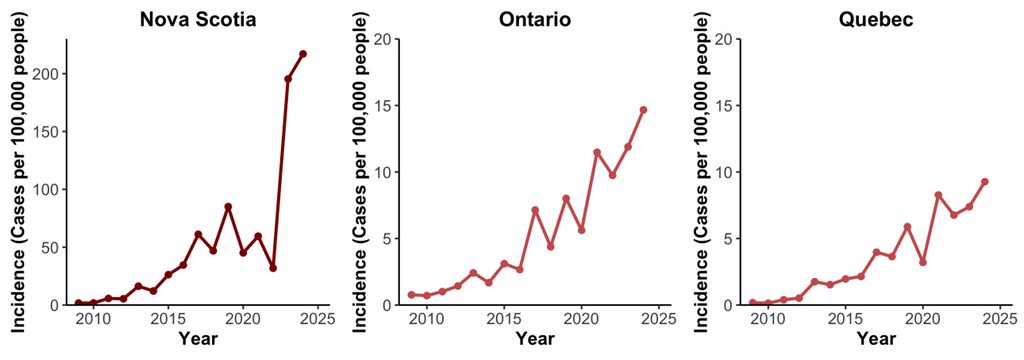
“The public health organization couldn’t cope,” Ogden said of Nova Scotia Lyme disease case counts. “There were too many cases for them to follow up.”
Provinces in addition to Nova Scotia are following a similar trajectory.
In Canada, where training for diagnosing and treating Lyme disease is variable and fragmented for health care providers, patients describe the challenges they faced trying to get a diagnosis.
Patients describe needing to seek medical attention from international specialists, such that their diagnosis isn’t included in the case numbers, even though they became infected in Canada.
This story is true in many towns, like Caledon, where Fosbury’s son contends with Lyme carditis. According to Fosbury, she was initially told that her son could not have Lyme disease; the pediatrician incorrectly claimed that there was no Lyme disease in Canada. Her son’s case was not captured in the national data because he traveled to see specialists in the US and Europe for his diagnosis.
Awareness and a call to action
Back in the Caledon council chamber, Fosbury concluded her remarks with a call to action: “People need to be educated. We need public awareness campaigns,” she said.
Councilors unanimously approved a motion calling for measures to reduce tick populations and stronger public education about tick-borne diseases.
At the level of prevention, information and awareness can mean the difference between recognizing a tick and overlooking it.
Nymphs, or baby ticks, are no bigger than a poppy seed, and they seem to have a special talent for tucking themselves into obscure body pockets: belly buttons, hairlines and other less inspected creases and folds.
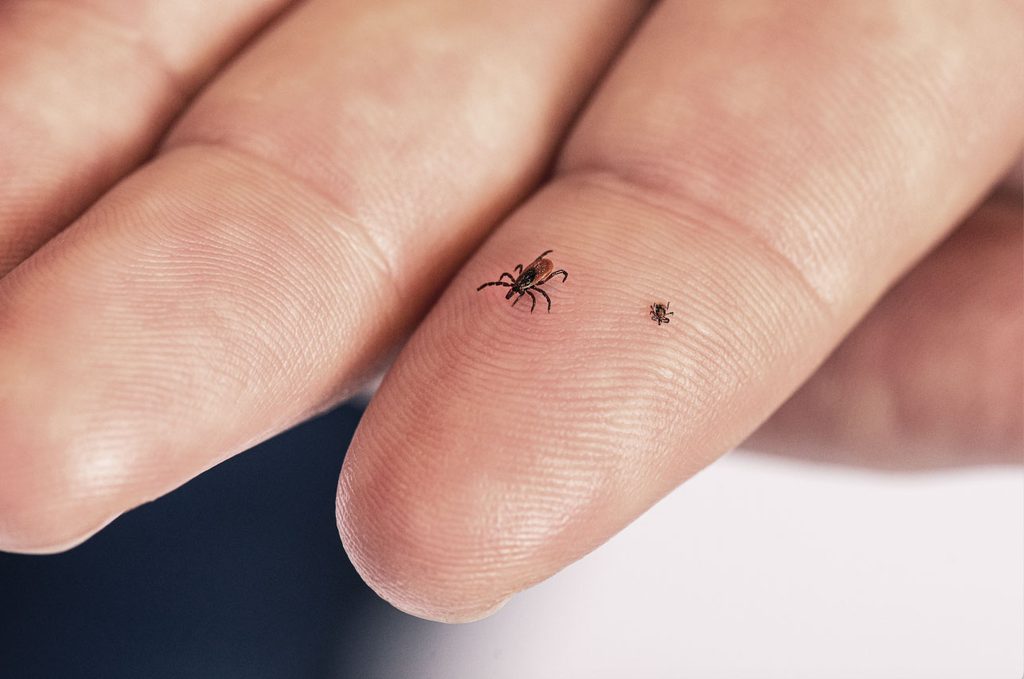
“They look like a speck of dirt,” said Dorothy Leland. “So, people have to learn to protect themselves.”
“We had no awareness about it at all.”
Officially, the Public Health Agency of Canada emphasized the importance of education and awareness for Lyme disease nearly a decade ago. The Federal Framework on Lyme Disease, an action plan released in 2017, identified education and awareness as one of its three central pillars. Five years later, an evaluation recommended expanding efforts to better disseminate information to Canadians and health-care providers. Since then, however, ticks have expanded into new areas and cases of Lyme disease have continued to climb, but no new action plan has been presented.
The Canadian Lyme Disease Foundation (CanLyme), says many Canadians still underestimate the disease. Survey data cited by the organization suggest people either don’t believe Lyme disease poses a significant risk or don’t know how to protect themselves.
“Many people are still minimizing the importance of Lyme disease,” said Janet Sperling, president of CanLyme, in an interview with Canada’s National Observer. “The biggest gap in prevention is consistent, widespread and actionable information.”
In many cases, awareness of Lyme disease has not come from communication from provincial or federal governments but rather from patients, impacted families and advocacy organizations.
Non-profit organizations, such as Canada’s G. Magnotta Foundation, are providing direction on proper tick removal. When Justin Bieber (yes, Canada’s prince of pop) announced his own diagnosis, he introduced millions of Canadians to Lyme disease for the first time.
Fosbury has organized events such as fun runs and has developed kid-friendly educational materials to understand the risk of ticks, but she worries that her efforts do not go far enough.
“I think it’s the government’s job to make people aware,” she said.
Ultimately, the new public health reality and lack of coordinated awareness campaigns are beyond her capacity to solve. She is intentionally focused on something much smaller: survival after a single tick bite that altered her son’s life.
“I only have so much time and energy, and my focus has been on my son,” she said.
This article was first published by Canada’s National Observer in July 2026.